


 Cart
Cart
 sales@molnova.com


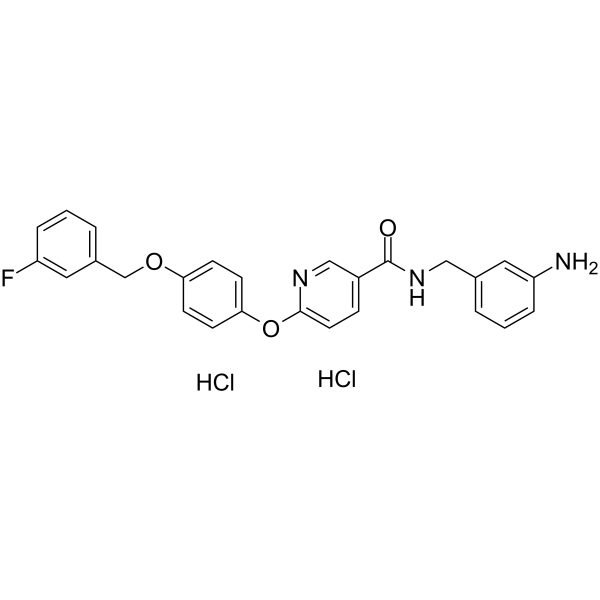
YM-244769 dihydrochloride
CAS No. 1780390-65-9
YM-244769 dihydrochloride( —— )
Catalog No. M28211 CAS No. 1780390-65-9
YM-244769 dihydrochloride is an effective inhibitor of Na+/Ca2+ exchange 3 (NCX3) with an IC50 of 18 nM. YM-244769 dihydrochloride has efficient protective effects on neurons and kidneys.
Purity : >98% (HPLC)
 COA
Datasheet
HNMR
HPLC
MSDS
Handing Instructions
COA
Datasheet
HNMR
HPLC
MSDS
Handing Instructions
| Size | Price / USD | Stock | Quantity |
| 5MG | 162 | Get Quote |


|
| 10MG | 249 | Get Quote |
|
| 25MG | 459 | Get Quote |
|
| 50MG | 791 | Get Quote |
|
| 100MG | Get Quote | Get Quote |
|
| 200MG | Get Quote | Get Quote |
|
| 500MG | Get Quote | Get Quote |
|
| 1G | Get Quote | Get Quote |
|
Biological Information
-
Product NameYM-244769 dihydrochloride
-
NoteResearch use only, not for human use.
-
Brief DescriptionYM-244769 dihydrochloride is an effective inhibitor of Na+/Ca2+ exchange 3 (NCX3) with an IC50 of 18 nM. YM-244769 dihydrochloride has efficient protective effects on neurons and kidneys.
-
DescriptionYM-244769 dihydrochloride is an effective inhibitor of Na+/Ca2+ exchange 3 (NCX3) with an IC50 of 18 nM. YM-244769 dihydrochloride has efficient protective effects on neurons and kidneys. (In Vitro):YM-244769 dihydrochloride (0.3 or 1 μM) efficiently suppresses the hypoxia/reoxygenation-induced cell damage in SH-SY5Y cells treated with NCX1 antisense (i.e., SH-SY5Y cells primarily expressing NCX3) more than in those treated with NCX3 antisense (i.e., SH-SY5Y cells primarily expressing NCX1). YM-244769 dihydrochloride (0.003-1 μM) inhibits the initial rates of 45 Ca 2+ uptake into NCX1, NCX2, and NCX3 transfectants with IC 50 values of 68±2.9, 96±3.5, and 18±1.0 nM, respectively, indicating that YM-244769 dihydrochloride is approximately four to five times more selective to NCX3 than other isoforms.
-
In VitroYM-244769 (0.003-1 μM) inhibits dose dependently the initial rates of 45Ca2+ uptake into NCX1, NCX2, and NCX3 transfectants with IC50 values of 68 ± 2.9, 96 ± 3.5, and 18 ± 1.0 nM, respectively.YM-244769 (0.3 or 1 μM) efficiently protects against the hypoxia/reoxygenation-induced lactate dehydrogenase (LDH) release in SH-SY5Y cells and in LLC-PK1 cells (1 μM).YM-244769 possesses reverse mode-selectivity.YM-244769 (1 and 10 μM) inhibits NCX current (INCX) in a concentration- and [Na+]i-dependent manner, the IC50 against the unidirectional outward INCX (Ca2+ entry mode) is 0.05 μM. The IC50 values against the bidirectional outward and inward INCX are similar and approximately 100 nM with a Hill coefficient of about 1.YM-244769 is trypsin-insensitive. Cell Viability Assay Cell Line:SH-SY5Y cells treated with NCX1 or NCX3 antisense Concentration:0.3 and 1 μM Incubation Time:Result:Hypoxia/reoxygenation-induced LDH release was significantly attenuated: reduction in cell damage was greater in cells treated with NCX3 antisense (by 61%) than in cells treated with NCX1 antisense (by 35%).0.3 or 1 μM efficiently suppressed the hypoxia/reoxygenation-induced cell damage in SH-SY5Y cells treated with NCX1 antisense more than in those treated with NCX3 antisense.
-
In VivoYM-244769 (0.1-1 mg/kg; p.o.; once) exhibits dose-dependently natriuretic action in mice and significantly increases urinary excretion of Ca2+ as well as Ca2+/Cr ratio. Animal Model:Wild-type C57BL/6J mice and NCX-KO mice Dosage:0.1, 0.3 and 1 mg/kg Administration:Oral administration, once Result:Caused a dose-dependent increase (up to approximately 200%) in urine volume and urinary excretion of electrolytes (Na+, K+ and Cl-). Natriuretic actions were equivalently observed in NCX1-KO and WT, but disappeared in NCX2-KO and double KO.
-
Synonyms——
-
PathwayGPCR/G Protein
-
TargetCalcium Channel
-
RecptorInfluenza A|Apoptosis
-
Research Area——
-
Indication——
Chemical Information
-
CAS Number1780390-65-9
-
Formula Weight516.4
-
Molecular FormulaC26H24Cl2FN3O3
-
Purity>98% (HPLC)
-
SolubilityIn Vitro:?DMSO : 100 mg/mL (193.65 mM)
-
SMILESC1=CC(=CC(=C1)N)CNC(=O)C2=CN=C(C=C2)OC3=CC=C(C=C3)OCC4=CC(=CC=C4)F.Cl.Cl
-
Chemical Name——
Shipping & Storage Information
-
Storage(-20℃)
-
ShippingWith Ice Pack
-
Stability≥ 2 years
Reference
1.Szoka L, et al. Santin and cirsimaritin from Betula pubescens and Betula pendula buds induce apoptosis in human digestive system cancer cells. J Cell Mol Med. 2021 Dec;25(24):11085-11096.
molnova catalog



related products
-
Heterophyllin B
Heterophyllin B effectively suppresses the adhesion and invasion of the human esophageal carcinoma cells by mediating the PI3K/AKT/β-catenin pathways.
-
HUP30
HUP30 is a potent vasodilating agent. HUP30 can stimulate soluble guanylyl cyclase, activate K+ channels, and block extracellular Ca2+ influx.
-
Nitrendipine
Nitrendipine is a calcium channel blocker with marked vasodilator action.
